


Product details
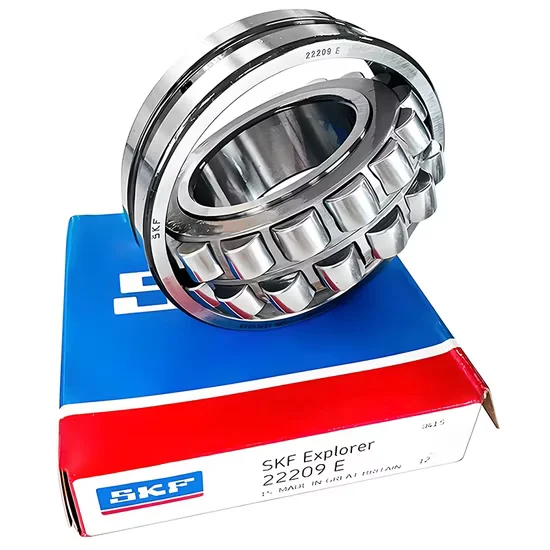
About SKF 23080CCK 23084CCK 23088CCK 23092CCK Spherical Roller Bearings Self-Aligning
Full-Brand Sourcing — Consolidate SKF 23080CCK spherical roller bearing orders with other premium lines in a single shipment, eliminating multi-vendor coordination, reducing freight costs, and simplifying your procurement workflow.
Technical Specifications
| Parameter | Value |
|---|---|
| Designation | SKF 23080CCK |
| Bearing Type | Spherical Roller Bearing |
| Bore Diameter (d) | 400 mm |
| Outside Diameter (D) | 600 mm |
| Width (B) | 148 mm |
| Bore Type | 1:12 Tapered Bore |
| Number of Rows | Double |
| Material | Bearing Steel |
| Load Direction | Radial |
| Separated | Unseparated |
| Origin | Sweden |
Note: The 'C' suffix remains unverified and requires manufacturer catalog confirmation for internal design specifics.
Application Suitability
| Industry | Typical Applications |
|---|---|
| Mining & Aggregates | Vibrating screens and primary crushers |
| Pulp & Paper | Paper machine dryer cylinders |
| Metallurgy | Steel mill continuous casting equipment |
Why Tapered Bore Mounting Ruins More SKF 23080CCK Spherical Roller Bearings Than Overloading
Improper heating methods destroy the metallurgical structure long before radial loads reach their limit.
I have seen maintenance crews in Chilean copper mines take dangerous shortcuts with open-flame torches on heavy-duty spherical roller bearings during emergency repairs. The localized overheating drastically alters the gold phase structure of the rings, causing severe roller spalling within just a few months of operation. When dealing with massive 400 mm bore components, controlled induction heating and precise drive-up measurements are absolutely non-negotiable to prevent catastrophic early failures. Ignoring these mounting protocols inevitably leads to massive financial losses and extended production halts.
Matching the Tapered Design to Heavy-Duty Vibratory Environments
The SKF 23080CCK spherical roller bearing utilizes a 1:12 tapered bore to ensure a highly secure, interference fit on tapered sleeves or shafts. This specific mounting method effectively prevents inner ring creep under the intense, continuous vibrations found in screening and crushing equipment. Our technical team actively assists global MRO buyers in verifying the exact clearance reduction needed during the drive-up process. Maintaining optimal operational clearance is vital for extending the service life of these massive components in demanding mineral processing facilities where equipment availability and throughput are absolutely paramount.
Navigating Shock Loads and Contamination in Mineral Processing
Crushers and vibrating screens subject bearings to severe radial shock loads and constant particulate contamination from the surrounding environment. The unseparated double-row arrangement maintains crucial structural integrity when the shaft deflects under these unpredictable dynamic forces. Adequate lubrication flow is critical to flush out microscopic debris and manage the friction heat generated by heavy oscillating movements. Without proper sealing arrangements at the housing level, abrasive dust rapidly compromises the bearing steel raceways and accelerates wear, leading to unexpected breakdowns and expensive secondary damage.
Decoding the Bore Geometry and Internal Clearance
The K suffix dictates the 1:12 tapered bore, which is essential for achieving the correct radial internal clearance after the mounting process is complete. Unlike cylindrical bore variants, the final operational clearance depends entirely on how far the inner ring is driven up the tapered seat. The double-row configuration provides exceptional radial load capacity while accommodating moderate axial loads in both directions. Selecting the appropriate initial clearance class compensates for the interference fit reduction and the thermal expansion typical in steel mill or paper machine applications, ensuring smooth rotation under load and preventing excessive heat generation.
The Hidden Toll of Incorrect Clearance and Mounting Shortcuts
Failing to calculate the exact drive-up distance or using the wrong initial clearance class leads to excessive preload or destructive internal looseness. According to established failure analysis frameworks, improper mounting and incorrect clearance account for a significant share of premature failures in heavy machinery. These avoidable mistakes result in unplanned downtime, catastrophic damage to the shaft and housing, and complete warranty voidance. Relying on proper engineering calculations rather than guesswork is the only way to protect your critical assets and maintain continuous production schedules.
Securing Genuine Heavy-Duty Bearings for Critical Assets
Sourcing authentic SKF 23080CCK spherical roller bearings requires strict verification, as the K suffix and large bore size are frequent targets for counterfeiting in the secondary market. We provide complete traceability documentation linking the physical batch codes directly to the manufacturer's production facilities. Our massive spot inventory covers thousands of standard and special part numbers, allowing us to consolidate this 400 mm bore bearing with other required MRO spares in a single container shipment. Furthermore, our cross-brand equivalent model consultation ensures you have viable alternatives like the 23084CCK or 23088CCK if project timelines are exceptionally tight, keeping your operations running smoothly.
Documentation & Authenticity
- Certificate of Conformity confirming Sweden origin for the 400 mm bore spherical roller bearing.
- Original manufacturer batch codes matching the outer ring laser etching.
- Dimensional inspection reports verifying the 1:12 tapered bore geometry.
- Material traceability documents confirming bearing steel metallurgical standards.
Storage, Handling & Mounting
- Store the unseparated bearing in its original packaging to protect the 400 mm bore from humidity-induced corrosion.
- Use controlled induction heating for the inner ring; never apply open flames to the bearing steel.
- Measure the drive-up distance precisely to achieve the required residual clearance on the tapered sleeve.
- Keep the bearing sealed until immediately before mounting to prevent abrasive dust ingress.
Preparing Your Technical Requirements for Verification
To ensure the SKF 23080CCK spherical roller bearing meets your exact operational demands, please share your detailed radial and axial load profiles, operating temperatures, and shaft speeds. Providing the OEM equipment number allows our engineering team to cross-reference the required clearance class and confirm the tapered sleeve compatibility. This comprehensive technical review guarantees the selected configuration aligns perfectly with your heavy-duty application, preventing costly mismatches before the equipment is even shipped to your facility and ensuring long-term reliability across your entire production line.
Frequently Asked Questions
Q: What does the K suffix indicate on this spherical roller bearing?
A: The K suffix specifies a 1:12 tapered bore, designed for mounting on tapered sleeves or shafts. This ensures a secure interference fit, preventing inner ring creep under heavy vibrations in crushers and screens, which is critical for maintaining operational stability.
Q: How do I cross-reference this model with larger bore sizes?
A: This 400 mm bore model belongs to a dimensional series that scales up sequentially. You can cross-reference it with the 23084CCK, 23088CCK, and 23092CCK for equipment requiring larger shaft diameters while maintaining the exact same tapered bore design and load characteristics.
Q: Which clearance class is best for vibrating screen applications?
A: Vibrating screens typically require a C3 or C4 clearance class to accommodate the interference fit reduction from the tapered mounting and the thermal expansion generated during high-frequency oscillating operations, ensuring the bearing does not unexpectedly seize under heavy load.
Q: How can I verify the authenticity of the bearing before installation?
A: Authenticity is confirmed by checking the original manufacturer batch codes laser-etched on the outer ring and scanning the official QR verification labels. We supply complete, verifiable traceability documentation with every single shipment to guarantee you receive genuine components.
Q: What is the recommended heating method for mounting this tapered bore bearing?
A: Controlled induction heating is mandatory for the inner ring. Open-flame heating destroys the metallurgical structure of the bearing steel, leading to rapid roller spalling and premature failure in heavy-duty applications, ultimately causing severe and costly damage to the surrounding machinery.