
Product details
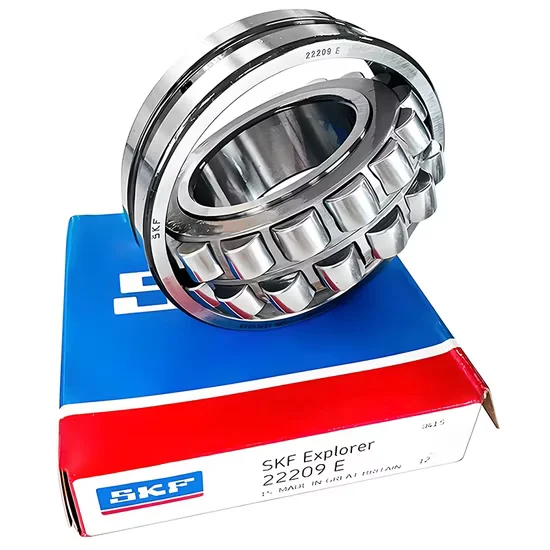
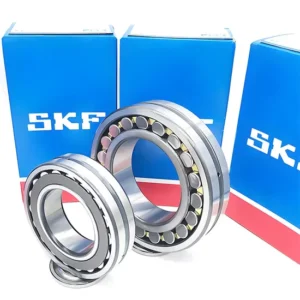
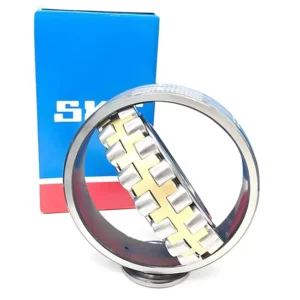
About SKF 22218K W33 C3 Spherical Roller Bearing Genuine Self-Aligning
Original Batch Traceability — Every SKF 22218 spherical roller bearing ships with verifiable manufacturer lot codes for complete supply chain transparency.
Technical Specifications
| Parameter | Value |
|---|---|
| Designation | SKF 22218 |
| Bearing Type | Spherical Roller Bearing |
| Bore Diameter (d) | 100 mm |
| Outside Diameter (D) | 215 mm |
| Width (B) | 47 mm |
| Number of Rows | Double |
| Material Options | Bearing steel or specialized material variants available upon request |
| Load Direction | Radial |
| Separated | Unseparated |
| Lubrication | Grease or Oil |
| Bore Type | 1:12 tapered bore (K) |
| Outer Ring Feature | Lubrication groove and three holes (W33) |
| Clearance Class | Greater than Normal (C3) |
| Origin | Sweden |
Application Suitability
| Industry | Typical Applications |
|---|---|
| Mining & Construction | Vibrating screens, crushers, and heavy earthmoving equipment |
| Metallurgy & Steel Mills | Continuous casters, rolling mill stands, and furnace conveyors |
| Pulp & Paper | Paper machine dryer cylinders and press sections |
Why Open-Flame Mounting Destroys the SKF 22218 spherical roller bearing
Direct torch heating alters the metallurgical structure, causing premature spalling under heavy radial loads.
In Chilean copper mines, I watched maintenance crews use open torches to heat bearings for shaft mounting. This reckless practice anneals the raceways, dropping hardness well below specification and triggering catastrophic early failures. The intense, localized heat from a flame destroys the carefully engineered microstructure of the bearing steel. Proper induction heating preserves the integrity of the SKF 22218 spherical roller bearing, ensuring the raceways maintain their load-carrying capacity under extreme vibratory stresses. Many plant managers underestimate how quickly thermal damage occurs, leading to repeated, unexplained breakdowns shortly after installation.
Aligning Misalignment Tolerances in Heavy Machinery
The double-row spherical design inherently compensates for shaft deflections and housing misalignments common in vibrating screens and crushers. By accommodating these dynamic structural shifts, the SKF 22218 spherical roller bearing prevents destructive edge loading on the rollers. When heavy equipment frames twist under operational stress, rigid bearings would quickly bind and fail. Our engineering team frequently cross-references OEM specifications to ensure this self-aligning capability matches the exact structural flex of your machinery. This proactive alignment verification significantly extends the service interval, reducing the frequency of costly component replacements in demanding mining environments.
Managing Extreme Loads and Contaminated Environments
Vibrating screens and crushers subject mechanical components to severe shock loads and relentless particulate contamination. The W33 lubrication groove ensures a continuous flow of fresh grease directly to the rolling elements, effectively flushing out abrasive dust before it can score the raceways. Meanwhile, the C3 internal clearance accommodates the thermal expansion generated by high-speed operation and friction. Selecting the correct tapered bore configuration also guarantees secure locking on the shaft without inducing excessive hoop stress. Without these specific design features, the combination of heavy radial impacts and airborne debris would rapidly degrade the bearing surfaces, leading to unpredictable equipment stoppages.
Decoding the K, W33, and C3 Suffix Configuration
The "K" designation indicates a 1:12 tapered bore, which allows for precise radial internal clearance adjustment during mounting on a tapered sleeve. The "W33" suffix confirms the presence of an annular groove and three lubrication holes in the outer ring, facilitating efficient relubrication without requiring complete machine disassembly. Finally, the "C3" clearance class provides the necessary internal gap to prevent roller skidding and binding when the component reaches elevated operating temperatures. Understanding these specific suffixes is critical, as substituting a standard cylindrical bore or normal clearance variant will drastically reduce service life in high-vibration applications. Maintenance teams must recognize that these suffixes are not optional accessories but fundamental engineering parameters that dictate the operational boundaries of the assembly.
The Financial Impact of Incorrect Clearance and Bore Selection
Specifying a standard clearance instead of C3 in a high-temperature steel mill environment leads to internal preload, accelerating fatigue and causing unplanned downtime. Similarly, ignoring the tapered bore requirement forces improper mounting practices that damage the shaft and void manufacturer warranties. These misconfigurations result in catastrophic damage to surrounding housings, gears, and drive motors. Adhering to ISO 281 guidelines for dynamic load rating calculations prevents these costly oversights. The true expense of a mismatched component is never just the replacement part; it encompasses the lost production hours, secondary mechanical damage, and emergency freight costs associated with sudden line stoppages.
Securing Authentic Components for Critical Operations
Sourcing genuine components requires more than just matching a part number; it demands rigorous supply chain verification and technical oversight. We maintain massive spot inventory covering thousands of standard and special part numbers, ensuring rapid dispatch for urgent MRO requirements across global mining sites. Our technical team provides cross-brand equivalent model consultation if lead times fluctuate, always verifying dimensional interchangeability and suffix alignment. Furthermore, every shipment includes complete traceability documentation, protecting your operation from the severe risks associated with counterfeit industrial parts. By combining flexible order consolidation with strict authenticity checks, we eliminate the procurement friction that typically delays critical maintenance projects.
Documentation & Authenticity
- Certificate of Conformity validating the Swedish origin and manufacturing batch.
- Original manufacturer lot codes for direct verification via official digital tools.
- Material inspection reports confirming bearing steel metallurgical compliance.
- Dimensional inspection data verifying the 100x215x47 mm tolerances before dispatch.
Storage, Handling & Mounting
- Store the unopened package in a dry, temperature-controlled environment to prevent corrosion on the exposed bearing steel surfaces.
- Use dedicated induction heaters for the 1:12 tapered bore; never apply open flames that destroy the raceway hardness.
- Monitor the drive-up distance and residual internal clearance during mounting to ensure the C3 gap is not eliminated.
- Connect automated lubrication systems directly to the W33 outer ring groove holes for optimal grease distribution.
Preparing Your Technical Parameters for Review
To facilitate accurate selection and L10 life recalculation, please share your specific radial and axial load profiles, operating speeds, and ambient temperature ranges. If you are replacing an existing unit, providing the OEM equipment serial number allows our engineers to perform a precise cross-reference check and verify the exact adapter sleeve requirements. Detailing the housing design, shaft locking mechanism, and environmental exposure ensures we supply the optimal configuration for your installation. Supplying these operational parameters enables our technical team to validate the internal clearance and lubrication strategy, ensuring long-term reliability in your specific application.
Frequently Asked Questions
Q: How can I verify the authenticity of the SKF 22218 spherical roller bearing using official tools?
A: You can authenticate the component by scanning the QR code on the packaging or entering the unique batch number into the manufacturer's official verification application. We provide complete traceability documentation, including the original certificate of conformity, ensuring every unit is sourced directly from authorized channels and fully compliant with quality standards.
Q: What are the critical alignment and clearance checks when cross-referencing the K W33 C3 configuration?
A: When evaluating equivalent models, you must confirm the 1:12 tapered bore, the outer ring lubrication groove, and the greater-than-normal internal clearance. Substituting a cylindrical bore or standard clearance variant will cause mounting difficulties and thermal binding. Our engineering team cross-checks these specific suffix attributes to guarantee exact dimensional and functional interchangeability.
Q: How do I select between grease and oil lubrication for this bearing in vibrating screen applications?
A: Vibrating screens typically require grease lubrication due to its superior sealing properties against abrasive dust and its ability to stay within the W33 groove under high-frequency oscillation. Oil is generally reserved for high-speed applications requiring rapid heat dissipation. We recommend consulting our technical support to match the lubricant viscosity with your specific oscillation frequency and load conditions.
Q: What are the proper induction heating requirements for mounting a 1:12 tapered bore bearing?
A: Induction heating must be strictly controlled to avoid exceeding the thermal limit of standard bearing steel, which would alter the metallurgical structure. The component should be heated evenly, and the drive-up distance on the tapered sleeve must be measured precisely to achieve the correct reduction in internal clearance. Never use open torches, as localized overheating causes immediate raceway annealing and premature spalling.