Tighter fits do not prevent slipping; they eliminate internal clearance and cause thermal lock-up.
Proper conveyor drum bearing replacement demands precise alignment, correct clearance matching to operating temperatures, and the use of genuine parts to prevent overheating and unplanned downtime. The core argument is that most premature failures stem from installation errors and incorrect specification rather than material fatigue alone.
I still remember the smell of burnt grease in a mining site control room. A maintenance manager was staring at a seized conveyor pulley, frustrated because he had just replaced the spherical roller bearings with what he thought were high-quality equivalents. The line had been down for two days. When we inspected the failed unit, the issue was not the load capacity but the fit. The installer had forced a tight fit to prevent any perceived slippage, ignoring the necessary C3 or C4 internal clearance required for thermal expansion. As the drum heated up during operation, the inner ring expanded against the shaft, eliminating all play and locking the bearing solid. This is a common pitfall I have seen repeatedly at industrial trade shows from Hanover to Chicago. Operators often believe that over-greasing extends life, but in reality, it churns heat and blows out seals, leading to rapid contamination and failure.
Understanding these mechanical realities is crucial for anyone managing MRO operations. The following guide breaks down why these failures happen and how to execute a replacement that lasts.
Why Do Conveyor Drum Bearings Fail Prematurely?
Misalignment and incorrect clearance are responsible for the majority of thermal failures in conveyor systems.
When a conveyor drum stops unexpectedly, the immediate assumption is often that the bearing reached the end of its fatigue life. However, data suggests that installation errors and environmental mismatches account for a significant portion of early failures. In my experience visiting aggregate quarries and cement plants, two specific issues dominate the failure landscape: misalignment and improper clearance selection.
Misalignment places uneven loads on the rolling elements. Even a slight angular deviation can cause one side of the bearing to carry the bulk of the load, leading to premature spalling and seal damage. I once consulted for a cement plant where repeated seal failures were traced back to a shaft that was not aligned within tolerance during the last overhaul. The seals wore out quickly, allowing dust to enter, which then abraded the raceways.
The second major culprit is clearance mismatch. Bearings generate heat during operation. If the internal clearance is too tight, this heat causes the inner ring to expand against the shaft, creating a condition known as thermal lock-up. Conversely, if the clearance is too loose, vibration increases, accelerating fatigue. Selecting the right clearance class, such as C3 or C4, depends on the operating temperature and the fit between the shaft and housing. Ignoring these factors turns a routine maintenance task into a recurring nightmare.
How to Select the Right Replacement Bearing?
Match load ratings and internal clearances to your specific operating temperatures and shaft tolerances.
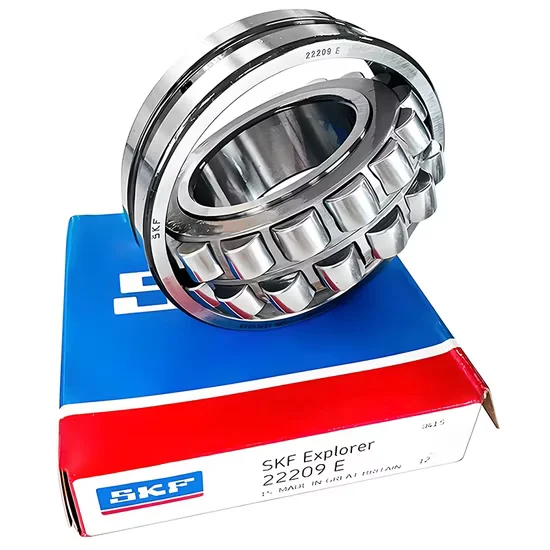
Selecting a replacement bearing is not just about matching the part number. It requires understanding the application’s demands. For conveyor drums, spherical roller bearings are the standard due to their ability to accommodate misalignment and heavy radial loads. However, not all spherical roller bearings are created equal. The key lies in the internal clearance and the cage design.
In high-temperature environments, such as near kilns in cement plants or in direct sunlight in desert mining operations, standard clearance (C0) is often insufficient. Here, C3 or C4 clearances are necessary to allow for thermal expansion without inducing preload. I have seen cases where using a standard clearance bearing in a hot environment led to failure within weeks, whereas a C3 variant lasted for years.
Another critical factor is the cage material. Steel cages are robust and suitable for high-load applications, while polyamide cages offer lower friction and better performance in high-speed scenarios. Choosing the wrong cage can lead to premature wear or melting in extreme heat.
| Feature | Standard Clearance (C0) | Increased Clearance (C3/C4) |
|---|---|---|
| Thermal Expansion Handling | Limited | Robust |
| Suitable Environment | Moderate Temperature | High Temperature / Tight Fits |
| Vibration Resistance | Standard | Enhanced |
| Load Capacity Impact | Nominal | Slightly Reduced due to larger balls/rollers |
When sourcing these components, authenticity is non-negotiable. Counterfeit or substandard bearings may look identical but lack the precise metallurgy and heat treatment required for heavy-duty service. I always recommend verifying the supply chain. A reliable supplier should provide traceability documentation and offer technical support to ensure the selected bearing matches the OEM specifications or offers a verified equivalent.
Step-by-Step Removal and Installation Guide
Use induction heaters for mounting and never hammer bearings into place.
Proper installation is as critical as proper selection. Hammering a bearing onto a shaft is a surefire way to damage the rolling elements and raceways. The force from a hammer is uneven and can create brinelling, which leads to early failure. Instead, use controlled heating methods to expand the inner ring for a smooth fit.
- Preparation: Clean the shaft and housing thoroughly. Remove any rust, burrs, or old adhesive. Inspect the shaft for wear. If the shaft is damaged, the new bearing will not seat correctly, leading to rotation and fretting corrosion.
- Heating: Use an induction heater to heat the bearing to the recommended temperature, typically around 110°C to 120°C. Do not exceed the manufacturer’s maximum temperature limit, as this can alter the steel’s microstructure. Avoid open flames or oil baths, which can introduce contaminants or cause uneven heating.
- Mounting: Quickly slide the heated bearing onto the shaft. Ensure it is pushed firmly against the shoulder. Use a sleeve or a dedicated mounting tool to apply even pressure if needed. Do not strike the bearing directly.
- Cooling: Allow the bearing to cool naturally. Do not quench it with water or compressed air, as rapid cooling can cause cracking or distortion.
- Seal Installation: Install the seals carefully, ensuring they are not twisted or pinched. Lubricate the seal lip with a small amount of grease to prevent dry running during startup.
I recall a case in a steel mill where a technician used a torch to heat a large bearing. The uneven heat caused the inner ring to distort slightly. Although it fit, the bearing ran hot and noisy from day one. It had to be replaced again after only a few months. Using the right tools, such as induction heaters and hydraulic nuts, ensures a precise and damage-free installation.
Alignment and Lubrication Best Practices
Laser alignment and precise greasing volumes prevent seal blowouts and extend service life.
Once the bearing is installed, alignment and lubrication determine its longevity. Misalignment, even if minor, creates additional stress on the bearing and seals. Traditional straight-edge methods are often insufficient for modern high-speed conveyors. Laser alignment tools provide the precision needed to ensure the drum is parallel to the frame and other rollers.
Lubrication is another area where more is not better. Over-greasing is a common mistake. Excess grease churning inside the bearing generates heat, which can degrade the grease and damage the seals. In severe cases, the pressure from over-greasing can blow out the seals, allowing contaminants to enter. The general rule is to fill the free space in the housing partially and replenish based on calculated intervals, not arbitrary schedules.
| Practice | Incorrect Approach | Correct Approach |
|---|---|---|
| Alignment Method | Straight-edge or visual check | Laser alignment system |
| Grease Volume | Fill until it purges from seals | Calculate based on housing volume and speed |
| Grease Type | Generic multi-purpose | Specific lithium complex or synthetic for high temp |
| Frequency | Fixed calendar interval | Condition-based or calculated runtime interval |
Using the wrong type of grease can also be detrimental. For high-temperature or wet environments, specialized greases with higher dropping points and water resistance are required. I advise consulting the bearing manufacturer’s guidelines for specific lubrication recommendations. Regular monitoring of grease condition and bearing temperature can help detect issues before they lead to failure.
Conclusion
Precision in selection and installation prevents costly downtime.
Conveyor drum bearing replacement is a technical task that requires attention to detail. From selecting the correct clearance class to using proper heating methods and ensuring precise alignment, every step matters. Avoiding common pitfalls like tight fits and over-greasing can significantly extend bearing life and reduce unplanned stoppages. By focusing on genuine parts and adhering to best practices, maintenance teams can ensure reliable and efficient conveyor operation.
What to state on your inquiry
A complete inquiry keeps the full model suffix and the specified execution, so the quote matches your parts list.
- Full SKF designationCopy every model suffix exactly as specified.
- Specified executionName any insulated, hybrid ceramic or clearance requirement.
- Motor and bearing positionGive the motor model and the position of each bearing.
- Quantity and deliveryList quantities, destination country, postcode and required date.