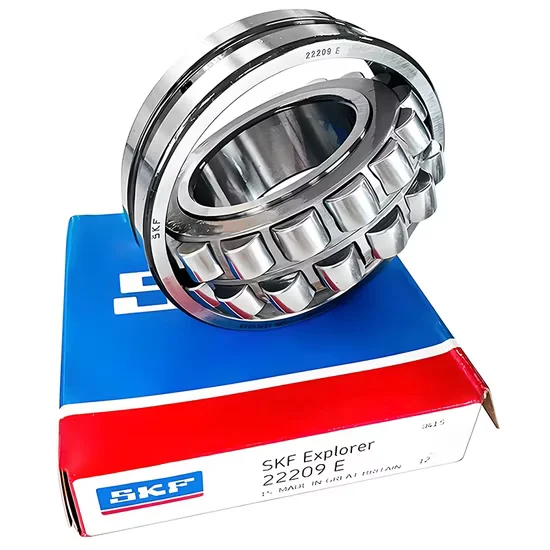
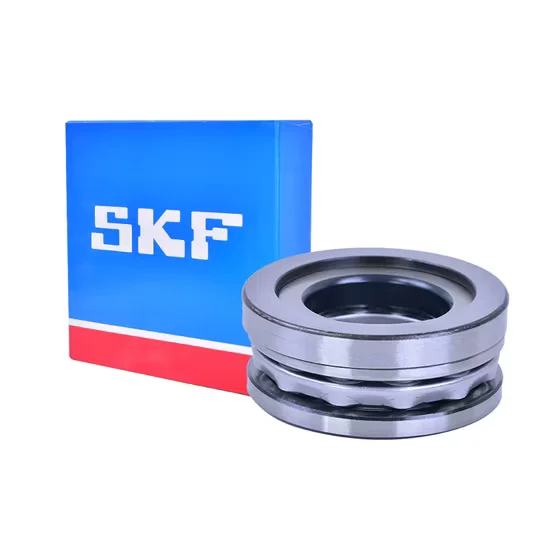
Thin-wall bearings fail not because of load, but because of ignored clearance and seal friction.
The core specification for the SKF 61906-2RS1 is not just its outer diameter or bore size, but the precise interplay between its thin-section geometry, C3 internal clearance, and the friction torque of its 2RS1 contact seals. Buyers must verify dimensional tolerances against ISO standards and demand traceability documentation to ensure the bearing can withstand thermal expansion without inner ring jamming or grease leakage.
I still remember the humidity in the Chicago convention center during a major power transmission trade show. A procurement manager from a precision equipment manufacturer was boasting about his cost savings on a recent bulk order of thin-section bearings. He had sourced what he believed were genuine units at a fraction of the standard market rate. Two weeks later, his production line stopped. The bearings hadn’t cracked under load; they had seized. The non-genuine seals had lost their integrity under moderate operating temperatures, allowing grease to escape while contaminants entered. The thin walls, lacking the proper internal clearance for thermal expansion, deformed and jammed the inner ring. That incident reinforced a critical lesson: in thin-section applications, the margin for error is nonexistent. You cannot treat a SKF 61906-2RS1 like a standard deep-groove ball bearing. The physics are different, and the consequences of mismatched specs are immediate and costly.
What Are the Core Dimensions of SKF 61906-2RS1?
The 61906-2RS1 is defined by its high diameter-to-width ratio, which demands strict adherence to ISO dimensional tolerances.
The "thin-section" designation is not merely a marketing term; it is a geometric reality that changes how the bearing reacts to mounting pressures and operational loads. For the SKF 61906-2RS1, the basic dimensions follow the ISO 15 standard for boundary dimensions, but the wall thickness is significantly reduced compared to standard series bearings. This reduction saves space and weight but reduces the structural rigidity of the rings.
When sourcing these components, buyers often focus solely on the bore (d), outside diameter (D), and width (B). However, the critical factor is the tolerance class. Genuine units maintain micron-level precision in roundness and parallelism. If the housing or shaft fits are too tight, the thin outer ring can distort, leading to premature fatigue. Conversely, if the fit is too loose, the bearing may creep, causing fretting corrosion.
| Dimension Parameter | Specification Characteristic | Verification Method |
|---|---|---|
| Bore Diameter (d) | Standard ISO tolerance | Micrometer measurement at multiple points |
| Outside Diameter (D) | Thin-wall specific tolerance | Ring gauge or coordinate measuring machine |
| Width (B) | Reduced section height | Caliper with depth probe |
| Chamfer Dimensions | Specific to seal retention | Visual inspection against technical drawing |
A European machine tool builder once reported vibration spikes in their spindles after switching suppliers. The issue was not the material quality but the batch consistency of the dimensional tolerances. Mixed batches with slight variations in width caused uneven preload distribution. By sticking to verified SKF 61906-2RS1 stock with complete traceability, such variability is eliminated, ensuring that every unit in a bulk order behaves identically under load.
Why Do 2RS1 Seals Matter in Thin-Section Bearings?
Contact seals on thin bearings generate more heat relative to their mass, making material composition critical.
The "2RS1" designation indicates that the bearing is equipped with two contact seals made of acrylonitrile-butadiene rubber (NBR). In standard bearings, the heat generated by seal friction is easily dissipated through the massive steel rings. In a SKF 61906-2RS1, the thin cross-section means there is less steel to act as a heat sink. If the internal clearance is too tight, the friction from the seals can raise the internal temperature significantly, leading to grease degradation and seal hardening.
Genuine SKF seals are engineered to balance sealing efficiency with low friction torque. Counterfeit or lower-quality alternatives often use inferior rubber compounds that harden quickly under thermal stress. Once the seal hardens, it loses its ability to follow minor runout or misalignment, creating gaps for contamination. In a recent case involving a food processing plant in Southeast Asia, non-genuine seals failed within months, allowing washdown water to contaminate the grease. The resulting corrosion destroyed the bearing raceways.
| Seal Attribute | Genuine Performance | Counterfeit Risk |
|---|---|---|
| Material Composition | High-grade NBR with specific additives | Unknown or recycled rubber mix |
| Friction Torque | Optimized for thin-section heat dissipation | Excessive, leading to thermal buildup |
| Grease Retention | High, even under vibration | Poor, leading to early lubrication loss |
| Temperature Resistance | Stable within specified operational range | Degrades rapidly at moderate temps |
Procurement teams must understand that the seal is not an accessory; it is an integral part of the bearing’s thermal management system. When evaluating a SKF 61906-2RS1 for wholesale, request data on seal friction torque. If the supplier cannot provide this technical detail, the risk of premature failure increases substantially.
How to Verify Internal Clearance for Precision Fits?
Thinner walls require looser internal clearance to accommodate thermal expansion and mounting distortion.
Internal clearance is the most overlooked specification in thin-section bearing procurement. The SKF 61906-2RS1 is typically available in Normal (CN) or C3 clearance. For applications involving significant temperature differences between the inner and outer rings, or where the bearing is mounted with a tight fit on the shaft, C3 clearance is often necessary.
Why? As the bearing operates, the inner ring heats up and expands. In a thin-section bearing, the outer ring is also more susceptible to distortion from the housing fit. If the initial internal clearance is too small, thermal expansion can eliminate the clearance entirely, leading to preloading. This preloading increases friction, heat, and eventually causes seizure.
Verifying clearance requires more than a feeler gauge. It involves measuring the radial play using specialized dial indicators or feeling the axial play while holding the bearing. However, for wholesale buyers, the best verification is documentation. Genuine bearings come with certificates that specify the clearance group.
- Check the Packaging: Genuine SKF packaging clearly states the clearance code (e.g., C3).
- Review the Certificate: Ensure the batch certificate matches the clearance requirement of your application.
- Spot Check: Use a dial indicator to measure radial play on a sample from the batch. Compare this against the standard limits for C3 or CN clearance.
A mining equipment operator in South America experienced repeated failures in conveyor pulleys. The root cause was identified as insufficient internal clearance. The bearings were installed with a tight fit, and the normal clearance was not enough to compensate for the thermal expansion and housing distortion. Switching to C3 clearance SKF 61906-2RS1 units resolved the issue, extending service life noticeably.
How to Spot Counterfeit 61906-2RS1 in Wholesale?
Counterfeiters mimic the logo but rarely replicate the metallurgical consistency and traceability codes.
The market for thin-section bearings is rife with counterfeits. These fake units often look identical to the naked eye but fail under real-world conditions. The differences lie in the steel purity, heat treatment, and manufacturing precision. Genuine SKF 61906-2RS1 bearings are made from high-purity steel with controlled inclusion levels, ensuring consistent fatigue life.
To protect your supply chain, implement a multi-layer verification process:
- Traceability Codes: Every genuine bearing has a unique identification code on the packaging and often on the bearing itself. Verify this code with the manufacturer or authorized distributor.
- Packaging Quality: Genuine SKF packaging uses high-quality materials with sharp, clear printing. Counterfeit boxes often have blurred logos, spelling errors, or flimsy construction.
- Dimensional Spot-Checks: As mentioned earlier, check the dimensional tolerances. Counterfeits often fall outside the strict ISO tolerance bands.
- Price Analysis: If the price is significantly lower than the market average, it is a red flag. High-quality steel and precision manufacturing have a baseline cost that cannot be undercut without compromising quality.
| Verification Point | Genuine Indicator | Counterfeit Warning Sign |
|---|---|---|
| Traceability | Unique batch code verifiable with supplier | No code or unverifiable generic code |
| Packaging | High-quality, sharp printing, robust box | Blurred text, spelling errors, weak cardboard |
| Steel Surface | Smooth, uniform finish, no discoloration | Rough spots, inconsistent grinding marks |
| Price | Competitive but aligned with market rates | Suspiciously low, below material cost logic |
We maintain a rigorous inbound inspection protocol for all SKF 61906-2RS1 inventory. Each batch is checked for dimensional accuracy and packaging integrity before being released for shipment. This ensures that our clients in over 80 countries receive only genuine products that meet their technical requirements.
Conclusion
Precision in thin-section bearings is non-negotiable.
Sourcing the SKF 61906-2RS1 requires a deep understanding of how thin walls interact with clearance, seals, and mounting fits. By focusing on verified dimensions, appropriate internal clearance, and genuine seal integrity, buyers can avoid the costly downtime associated with premature bearing failure. Trustworthy suppliers provide not just the product, but the traceability and technical support needed to ensure every unit performs as designed.
What to state on your inquiry
A complete inquiry keeps the full model suffix and the specified execution, so the quote matches your parts list.
- Full SKF designationCopy every model suffix exactly as specified.
- Specified executionName any insulated, hybrid ceramic or clearance requirement.
- Motor and bearing positionGive the motor model and the position of each bearing.
- Quantity and deliveryList quantities, destination country, postcode and required date.